



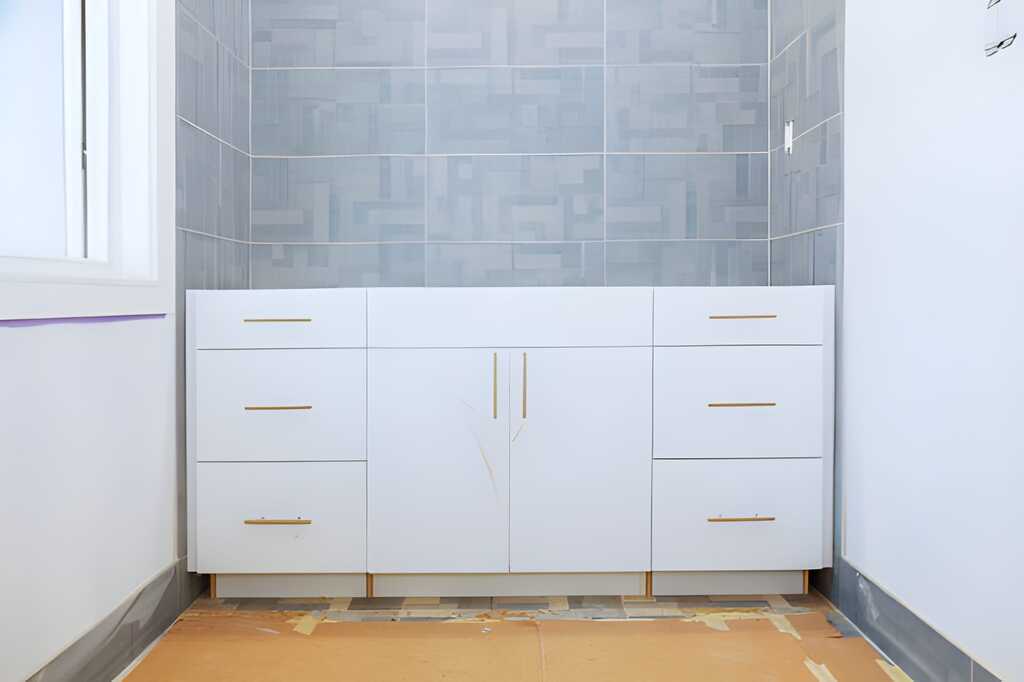
If you live in Toronto, you know that our climate is a study in extremes. We oscillate between the tropical, soup-like humidity of July and the bone-dry, radiator-heated air of February. While we adjust our wardrobes and thermostats to cope, the millwork in our homes, specifically in the bathroom, is fighting a silent battle every single day.
For homeowners searching for bathroom cabinets Toronto has to offer, the visual design is usually the priority. We obsess over Shaker vs. Slab doors, White Oak vs. Walnut, and Matte Black vs. Brushed Gold hardware. However, the accurate measure of a luxury bathroom renovation isn’t how it looks on installation day. It’s how it looks three, five, or ten years later.
The bathroom is the most hostile environment in your home for wood furniture. It is a wet zone subjected to rapid temperature spikes, steam, direct water splashes, and chemical cleaning agents. When you combine these daily stressors with Toronto’s seasonal hygroscopic swings (the expansion and contraction of wood due to humidity), standard furniture doesn’t stand a chance. This is why the oversized box store vanity you buy today often starts peeling, swelling, and cracking by year three.
At Jatoba Kitchens and Millwork, we believe in engineering before aesthetics. This guide is a deep dive into the materials science behind custom bathroom cabinets that Toronto homeowners rely on for longevity. We are pulling back the curtain on substrates, chemistry, and construction methods to help you make an educated investment in your home.
The Foundation: Understanding Substrates
The substrate is the core material that your cabinet box and doors are made of. In the world of custom bath cabinets, what lies beneath the paint or veneer is the single most critical factor in water resistance.
The Failure of Particle Board
To understand quality, we must first understand failure. The vast majority of pre-fabricated vanities found in retail stores are constructed from Low-Density Fiberboard (LDF), commonly known as particle board. This material consists of sawdust and wood chips bonded together with a weak resin.
In a dry environment like a living room, particle board is acceptable. In a humid bathroom, it is a ticking time bomb. Particle board is highly porous. Once steam penetrates the thin outer layer (usually a cheap melamine foil), the wood chips act like a sponge. This leads to thickness swelling—a permanent deformation where the material puffs up, typically at the bottom edges where water pools on the floor. Once a particle board swells, it loses its structural integrity; screws strip out, hinges sag, and the vanity is effectively ruined.
Marine-Grade Plywood vs. Moisture-Resistant MDF
When we design custom-made bathroom cabinets, we rely on two superior substrates, each with a specific engineering purpose.
A. Marine-Grade and Cabinet-Grade Plywood
For the structural carcass (the box itself) of your vanity, plywood is the gold standard. Unlike particle board, plywood is constructed from thin sheets of wood veneer (plies) glued together in alternating directions (cross-lamination).
- Dimensional Stability: Because the grains run perpendicular to each other, the layers restrain each other’s movement. When Toronto’s humidity spikes, the plywood resists warping far better than solid wood.
- Screw Holding Power: Plywood anchors screws tightly, ensuring that your heavy stone countertop and wall-hung floating vanity remain secure for decades.
- Water Resistance: We utilize plywood bonded with Phenolic resin, a waterproof adhesive that prevents delamination even if a plumbing leak occurs under the sink.
B. High-Density Moisture Resistant (MR) MDF
There is a misconception that all MDF (Medium Density Fiberboard) is cheap. This is false. There is a massive difference between Standard MDF and the Moisture-Resistant HDF (High Density Fiberboard) used in high-end millwork.
- The Green Core Difference: If you cut open a raw sheet of MR-MDF, you will often see a green tint. This indicates the presence of specific resins designed to repel moisture.
- Why Use it for Doors: For painted custom bathroom cabinets, MR-MDF is actually superior to solid wood. Solid wood expands and contracts with the seasons. If you paint a solid wood door, these movements will eventually crack the paint at the joints (a defect known as a hairline fracture). MR-MDF is perfectly stable and monolithic, providing a glass-smooth surface for paint that will never crack, warp, or twist, regardless of the humidity in your bathroom.
The Chemistry of the Finish: Why Paint is Not Enough
Many DIY enthusiasts or general contractors will attempt to spray bathroom cabinets with standard latex or oil-based paints found at a local hardware store. While these paints look good initially, they lack the chemical hardness (cross-linking) required for a bathroom environment.
For bathroom cabinets Toronto residents can trust, we use industrial-grade conversion varnish (CV) or 2K Polyurethane systems. Here is the science behind why this matters.
Post-Catalyzed Conversion Varnish
This is the industry standard for high-end kitchen and bath millwork. Unlike standard paint, which dries by evaporation (the solvent leaves, the solid remains), Conversion Varnish dries by chemical reaction.
- The Catalyst: Before we spray your cabinets, we add an acid catalyst to the finish. This triggers a molecular cross-linking process.
- The Bond: As the finish cures, it bonds tightly to the wood fibres and forms a non-porous, plastic-like shell.
- Chemical Resistance: A CV finish is tested to withstand common bathroom acids and alkalis. You can spill nail polish remover (acetone), mouthwash (alcohol), or bleach-based cleaners on a Jatoba vanity, and the finish will not soften or discolour. Standard latex paints will often become gummy or stained under these conditions.
2K Polyurethane (The Waterproof Shield)
For ultra-modern, high-gloss, or slab-style custom bathroom cabinets, we often deploy 2K Poly (Two-Component Polyurethane). This is similar to the clear coat used on luxury automobiles.
- Moisture Vapour Transmission Rate (MVTR): This metric measures how much moisture passes through a finish. 2K Poly has an incredibly low MVTR, effectively hermetically sealing the wood substrate. It is the closest you can get to a truly waterproof wood cabinet.
The Edge of Disaster: Sealing the Weak Points
Water is opportunistic. It does not attack the face of a door; it attacks the edges. The edge of a cabinet door is where the end-grain is exposed, and it is the most absorbent part of the panel.
The Danger of Thin Tape
In mass-produced waterproof bathroom cabinets that Toronto retailers sell, the edges are often covered with a thin paper or 0.5mm PVC tape. Over time, the heat from your shower weakens the glue. The tape begins to peel, exposing the raw particle board beneath to the steam. This is the beginning of the end for the cabinet.
The Millwork Solution: 1mm-3mm PVC & PUR Glue
To withstand the daily wear of a Toronto bathroom, industrial edge-banding technology, often absent in budget manufacturing, is essential. This is the level of detailing that separates a temporary fixture from a permanent investment.
Thicker Banding: Quality cabinetry should feature 1mm to 3mm thick PVC or ABS edge banding. Unlike the paper-thin tape found on standard furniture, this heavy-duty banding acts as a robust bumper. It effectively shields the door edges from physical impacts, like the swing of a laundry basket, while creating a deep, durable seal against water ingress.
PUR Adhesive: The glue used to apply this banding is just as critical. Standard edge banders typically use EVA glue (hot melt), which can reactivate and loosen if exposed to high heat, such as from a hair dryer or steam cleaner.
- The Superior Choice: High-performance millwork utilizes PUR (Polyurethane Reactive) adhesive. Once PUR glue cures, it becomes chemically inert and completely waterproof. This technology creates an imperceptible zero-joint line that locks moisture out, ensuring the core material remains dry even in a steamy bathroom.
Hardware Hygiene: Preventing Rust in the Wet Zone
When sourcing custom bath cabinets, the hardware is often an afterthought. However, in a humid bathroom, cheap steel rusts quickly. The humidity in a bathroom accelerates oxidation, leading to squeaky hinges and drawer slides that seize up.
The Galvanization Grade
- High-quality millwork relies exclusively on top-tier hardware manufacturers.
- Cycle Testing: Standard slides are typically rated for 50,000 cycles. In contrast, hardware specified for custom-made bathroom cabinets should be rated for 100,000+ cycles to ensure longevity.
- Corrosion Resistance: The industry standard for wet zones is nickel-plated steel hinges and drawer runners. The nickel plating functions as a robust shield, protecting the steel core from the oxygen and moisture in the air.
- Soft-Close Technology: Beyond luxury, soft-close is a preservation feature. By preventing doors and drawers from slamming, it reduces vibration and stress on the joinery, ensuring the cabinet box stays square and tight for years.
Construction Mechanics: Built for the Float
One of the most popular trends in Toronto condos and homes is the floating vanity. This design creates a sense of space by mounting the cabinet to the wall, hovering above the floor.
While beautiful, a floating vanity presents a massive structural challenge. A standard vanity rests on the floor, which supports the weight of the heavy stone countertop and sink. A floating vanity must support hundreds of pounds of quartz and porcelain solely through its back panel.
The Structural Back
- In economy vanities, the back panel is often a flimsy piece of 1/8″ hardboard, similar to a clipboard. A floating vanity simply cannot be hung securely with this material.
- The Method: Robust floating custom bathroom cabinet designs utilize a solid 3/4″ plywood back panel, added (grooved) into the sides, top, and bottom of the cabinet structure.
- French Cleat Systems: Professional installation often utilizes a French Cleat method. This involves interlocking 45-degree angled strips—one bolted to the wall studs, the other integrated into the cabinet. This distributes the sheer weight across the entire width of the vanity, rather than relying on a few screws, ensuring the vanity never sags or pulls away from the wall.
Toronto-Specific Considerations: The HVAC Factor
Designing for Toronto requires respecting our unique HVAC challenges. In older Toronto homes (like those in The Annex, Cabbagetown, or High Park), bathrooms may be poorly insulated or rely on radiator heat.
The Humidity Rollercoaster
- Winter (Dry): Furnace heat drops indoor humidity to 20-25%. Wood shrinks.
- Summer (Wet): Humidity rises to 50-60%. Wood expands.
If your cabinet maker does not account for this, your solid wood doors will warp. It is essential to engineer custom bathroom cabinets with floating center panels. You can use Space Balls (rubber spacers) inside the door frame that compress when the panel expands in summer and expand when the panel shrinks in winter. This keeps the door centred and rattle-free, preventing the wood from splitting apart during February’s deep freeze.
The Cost of Quality: Price vs. Value
We understand that custom bathroom cabinets represent a higher upfront cost compared to off-the-shelf options. However, when you analyze the cost per year of ownership, custom millwork is frequently the more intelligent financial decision.
- The Big Box Cycle: Buy a vanity for $1,200. Install it ($500). Replace it in 5 years when it swells ($1,700 + demolition costs).
- The Custom Investment: Buy a custom vanity for $3,500. It lasts 20+ years. It adds tangible value to your home appraisal because it is a permanent fixture, not disposable furniture.
In the competitive Toronto real estate market, buyers are savvy. They can spot the difference between a high-end renovation and a flip. High-quality, waterproof millwork signals to a buyer that the home has been cared for, increasing your eventual resale value.
Maintenance: Protecting Your Investment
Even the highest quality waterproof bathroom cabinets in Toronto require proper care to maintain their showroom shine. With the use of Industrial Conversion Varnish, maintenance is simple but specific.
- No Wax or Polish: Never use wax-based polishes (like Pledge) on custom millwork. The wax builds up over time and attracts dust, dulling the finish.
- Mild Soap Only: The best cleaner is a mixture of warm water and a drop of mild dish soap. Wipe down with a damp (not soaking) microfiber cloth, and, crucially, dry it immediately.
- Humidity Control: The best thing you can do for your bathroom cabinets (and your health) is to ensure your bathroom exhaust fan is sized correctly for the room. Run the fan for 20 minutes after your shower to evacuate the steam that settles on your cabinetry.
Invest in Millwork That Outlasts the Elements
A bathroom renovation is one of the most significant investments you will make in your home. Don’t let humidity, steam, and daily wear compromise that value. At Jatoba Kitchens and Millwork, we don’t just build cabinets. We engineer permanent solutions tailored to your specific lifestyle and Toronto’s unique climate.
From marine-grade cores to industrial waterproof finishes, our team ensures every inch of your project is built to withstand the test of time. We apply this same rigorous standard of engineering excellence to every room in your home. Whether you are planning a spa-inspired master ensuite renovation or are finally ready to break ground on one of our signature custom kitchens, Toronto homeowners rave about, we are ready to bring your vision to life.
Stop settling for disposable furniture. Let’s build something exceptional together. Schedule your complimentary design consultation today.
Leave A Comment